WIDEDIST
MULTI-FX.
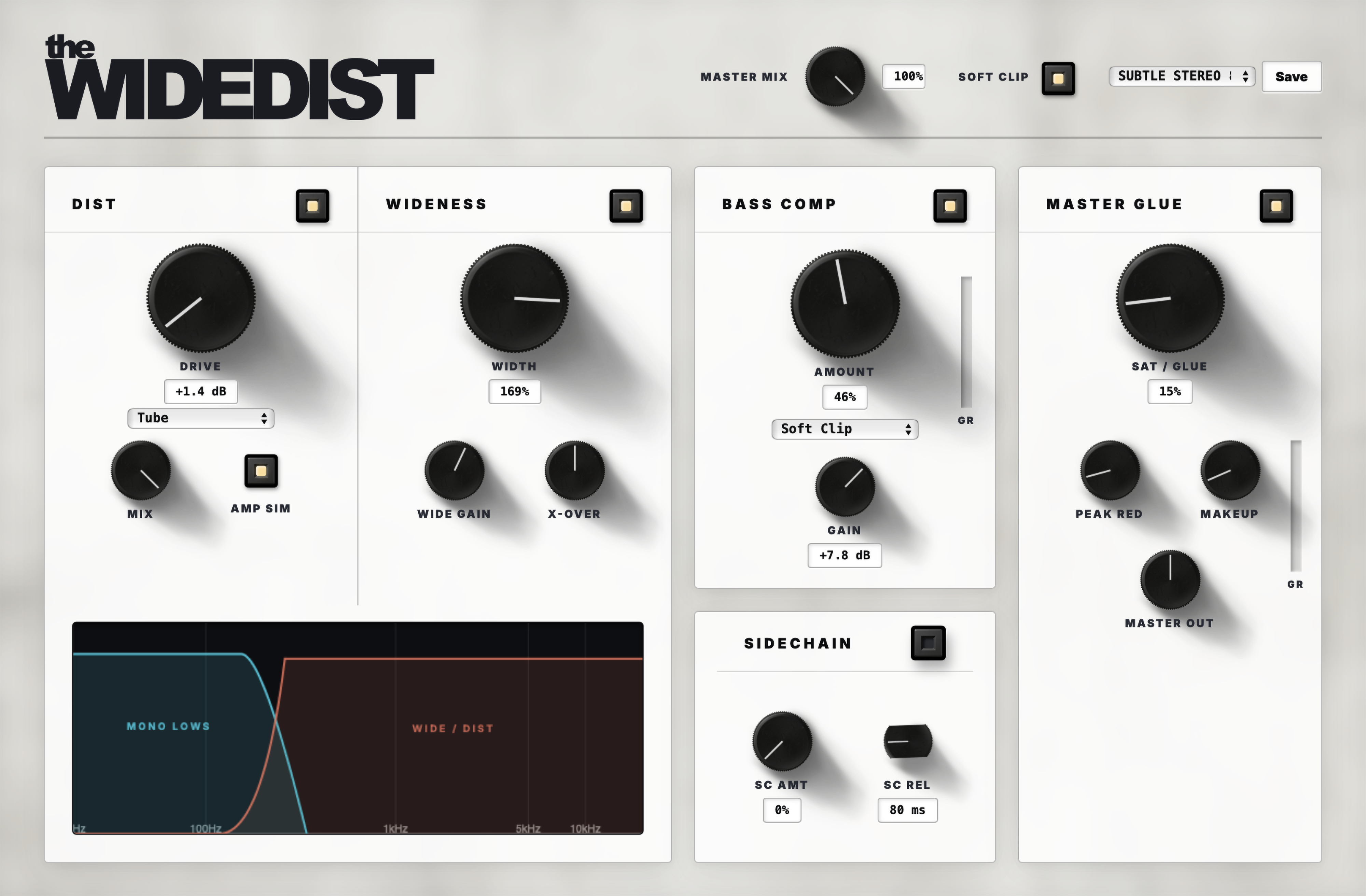
The ultimate wide distortion processor. Saturate mid and high frequencies to add massive character while preserving a tight, mono sum low-end.
CORE CAPABILITIES
Surgical multiband saturation, stereo imaging, and phase control
Wide Stereo Distortion
Add massive vintage tube warmth, soft clipping saturation, or aggressive hard clipping to mid and high frequencies to cut through any mix.
Phase-Safe Haas Imaging
Expand the stereo image of your high band using Haas sub-millisecond offsets, guarded by strict boundaries to guarantee absolute mono compatibility.
Sub-Mono Sum Lock
Sums all low-end frequencies below your crossover to 100% mono, feeding a dedicated compression block to keep sub-bass centered and heavy.
AUDIO EXAMPLES
Toggle between the raw signal and the WIDEDIST processed output. Hear how the wide distortion adds massive character while preserving a tight, mono lowend.
DSP SIGNAL FLOW
Step-by-step audio pathway through the WIDEDIST architecture
Signal Frequency Split
The stereo signal is divided at a custom frequency boundary (e.g. 120Hz) using a 4th-order Linkwitz-Riley filter matrix, branching the signal into two isolated processing paths.
Mono Summing & Bypass
All frequencies below the crossover point are summed to 100% mono and routed through either a dedicated low-end compressor or a soft clipper (bypassing the high-frequency distortion and widening stages). This processes low-end dynamics and transient weight, keeping your sub-bass centered, punchy, and controlled.
Tri-Mode Harmonic Waveshaping
The high passed signal is fed into your chosen saturation stage (Tube, Soft Clip, or Hard Clip), generating warm vintage harmonics or aggressive square-wave grit across the mid and high frequency spectrum.
Sub-Millisecond Haas Delay
To create massive width, the distorted signal is processed with sub-millisecond delay offsets between left and right channels. Precision delay boundaries protect mono compatibility when folded back to mono.
Glue Compression Module
A post-widening dynamics compressor catches sharp transients generated by clipping, balancing dynamic peaks and seamlessly gluing the dry and wet paths together.
Band Re-Combination
The low-end mono path and the processed high-end stereo wide path are recombined. The result is a massive, widely distorted sound that retains full low-end weight, tightness, and mono compatibility.
WIDEDIST
- ✓ AU and VST3 formats (Mac & PC)
- ✓ macOS 10.13+ & Windows 10/11 (Apple Silicon Native)
- ✓ Instant Digital Key Delivery
- ✓ Free Lifetime Updates